Tuesday, November 28, 2017

Just One More Drink

Alcohol abuse is the leading cause of sexual dysfunction, including disturbances in sexual desire, erectile achievement, and impotence. There was a study conducted measuring the prevalence of sexual dysfunction in alcohol-dependent men by Bijil Simon Arackal and Vivek Benegal. In this study, they asked men between the ages of 20-50 years old admitted to treatment centers that were married or had a regular sexual partner with a diagnosis of alcohol dependence syndrome to complete a sexual dysfunction checklist. About 37% of all subjects reported suffering from premature ejaculation, the majority reporting that they ejaculated within the first minute of intercourse. The study found a strong correlation between the number of sexual dysfunctions subjects reported and the amount of alcohol consumed per day, suggesting an increase in sexual dysfunction development with an increase in alcohol consumption. The study concluded with the notion that sexual dysfunction can come from psychogenic sources that can act as a comorbidity which they did not test, limiting the findings of the study. Interestingly, there was no evidence suggesting that sexual dysfunction development was dependent on age or the number of years of alcohol dependence.

This study is important because a 2015 National Survey on Drug Use and Health reported that 15.1 million adults had an alcohol use disorder, 8.4% of which were men. While a 2017 study shows that there has been a rise in alcohol consumption, namely an increase between 2001-2002 as compared to 2012-2013 in high-risk populations. Suggesting that sexual dysfunction may be on the rise, especially within high-risk populations as more people are reporting having an alcohol dependence disorder.

Monday, November 27, 2017

DNA and RNA make muscle fibers...

Scientists have recently discovered that DNA and RNA make muscle fibers. I know what you are thinking, did you get your information from a biology textbook written in 1965? Well, you would be misinterpreting what I am saying. Scientists from Stanford University have recently been able to construct sliding filament models only with DNA and RNA interacting with actin instead of myosin heads.
Normally, a muscle contracts when myosin heads move actin with the expenditure of ATP. This is a one directional motion that consists of a contraction phase where the myofibril is shortened and the relaxation phase where the muscle cell passively relaxes.
Figure 1
The biomechanical motors use RNA arms to interact with actin filament as seen in figure 1. By creating a tetramer of RNA arms they have constructed a rotatory device that interacts with the actin filament shown in figure 2. With this device, they have created two separate biomechanical motors. The first contains a stationary RNA motor that moves the actin filament in and out much like a muscle fiber. I say in and out because by adding a set of two DNA constructed switches, they are able to reverse the direction of the tetramer motor allowing the motor to be bidirectional. This precedes the abilities of a normal muscle fiber. The RNA model can also be activated through ions or photons of light.
Figure 2
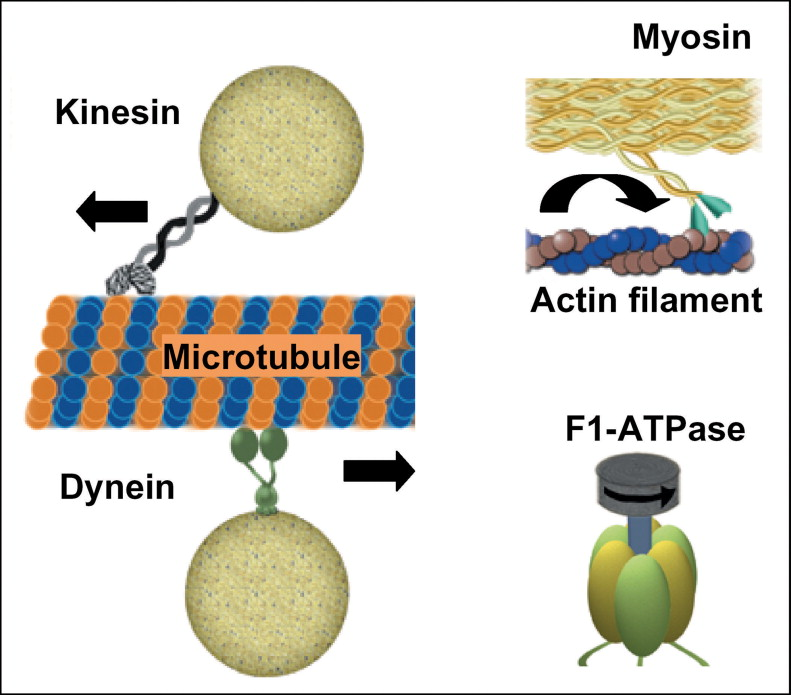
The second model involves a stationary actin filament and a mobile RNA tetramer that acts like a train car running along a track. This functions similar to kinesin moving along microtubules. The biomechanical motors can be set up to perform a multitude of different tasks simultaneously.
The practical applications for this are to one day provide prosthetics for damaged structures but on a cellular level.  Many structures in the body use biomechanical motors like muscle fibers and kinesin but also structures like cilia and even F1 ATPase. They also see practical applications in the transportation of molecular cargo. Ultimately they would like to genetically encode them into cells to allow them to perform intracellular tasks.
Figure 3
Currently, artificially created motors are far less efficient at converting chemical energy to mechanical energy and vice versa, but the hope is to one day precede or diversify the abilities of cellular motors. These motors have a long ways to go, but it is considered to be the most advanced engineered biomolecular motor currently created and can be the foundation for many technological advancements of the future.   
         
References
Biomolecular motors. (2005, December 07). Retrieved from http://www.sciencedirect.com/science/article/pii/S1369702105712864

Borman, S. (n.d.). Engineered myosin motor uses RNA arm to march on protein fibers. Retrieved from https://cen.acs.org/articles/95/i45/Engineered-myosin-motor-uses-RNA.html

Sunday, November 26, 2017

Asthma and Obesity in Children

The obesity rate in America is rapidly rising especially with more fast food chains and less home grown fruits and vegetables. With this rise in obesity comes a rise in several different diseases such as diabetes and asthma prevalent in children. Asthma is one of the most common diseases in children and even more common in children that are overweight or obese. There are many reasons for this being the case. With obese children, there is a skewed immune response in a specific cell called the T-helper type 1. This is found in the pulmonary tract and can be traced to pulmonary deficits. High-density lipoprotein (HDL) is not found as much as it should be with greater levels of low-density lipoprotein (LDL). Insulin resistance also increases because of increasing obesity which in turn mediates the association of the Th1 polarization and the pulmonary function. This hinders breathing and being able to fully digest foods because of the lack of insulin being secreted.
            The studies have shown that there is a definite obesity-related asthma phenotype and we have been able to identify the complex relationship between metabolic dysregulation, systemic inflammation, and pulmonary function deficits in children that are obese with asthma.  

https://www.ncbi.nlm.nih.gov/pubmed/29161075 

Head to body Transplant - Not Totally SciFi

There have been many different types of organ transplants that have improved peoples quality of life in recent years, but what if the head was the transplant, the control center of all individuals? I know what you’re thinking, “A human head transplant. Is that even possible”? According to surgeons Sergio Canavero and Xiaoping Ren it is, and it’s not just science fiction. Through HEAVEN/GEMINI, a spinal cord fusion procedure, transplantation may be possible (1,2). The first step of this project is to cool down/freeze the donor's (brain dead) spinal cord and the recipient's (physically disabled) head to around 12℃ by a process called autocerebral hypothermic perfusion where the recipient's head receives a cooling circuit through a pressure house to the carotid artery (2). Once cooled, both donor and recipient spinal cords are finely transected along regenerative axons while veins and arteries are cut (2). Once the recipient's head is fully severed, it is transferred to the donor body where spinal cord, veins, and arteries are connected microscopically with clamps, screws, wires and cables to support the new model (2). Plastic surgery to reconnect the skin is the last step (2).
The question now is will this really work? This question is not yet clear. Total spinal cord transection and reconstruction was successful in both rats and a dog, although these test subjects were not placed onto a new body (3,4). Respiration and behavior were merely the same post-operation as before in these subjects, however some subjects became paraplegic (3,4). The same was true for White et al. in which a laboratory monkey was the subject (5).
I suppose the biggest question here isn’t whether the procedure works or not, but whether the procedure is ethical from a biomedical standpoint. My immediate answer to this question was, “of course it’s not ethical, it’s crazy!” As I read more about this subject, I can now see the other side more clearly. A procedure like this could potentially better the lives of millions of people living with incurable muscular dystrophy, para/quadriplegics, and people who have any other form of incurable physical degenerative disease. Wanting to improve these people’s lives directly follows the biomedical ethical values. At the same time, if the procedure is unsuccessful all the ethical values can be broken. This debate only postpones the first attempt as we keep asking ourselves, “Where do we draw the line with transplantation?”  

References:
(1) Xiaoping, R., Canavero, S. (2017) HEAVEN in the Making: Between the Rock (the Academe) and a Hard Case (a Head Transplant). AJOB Neuroscience, volume 8:4, pages 200-205. DOI:10.1080/21507740.2017.1392372
(2) Canavero S. (2013). HEAVEN: The head anastomosis venture Project outline for the first human head transplantation with spinal linkage (GEMINI). Surgical Neurology International. DOI:10.4103/2152-7806.113444
(3) Kim, C.Y. (2016). PEG-assisted reconstruction of the cervical spinal cord in rats: effects on motor conduction at 1h. Spinal Cord, volume 54, pages 910-912. DOI:10.1038/sc.2016.72
(4) Kim, C.Y., Hwang, I.K., Kim, H., Jang, S.W., Kim, H.S., Lee, W.Y. (2016). Accelerated recovery of sensorimotor function in a dog submitted to quasi-total transection of the cervical spinal cord and treated with PEG. Surgical Neurology International, volume 24, pages 637-640. DOI:10.4103/2152-7806.190476
(5) White RJ, Wolin LR, Massopust LC Jr. Taslitz N, Verdura J. (1971).Cephalic exchange transplantation in the monkey. Surgery, volume 70, pages 135–139.

Ethical Dilemmas With Doping in Olympic Sports

Everyone loves to watch the Olympics because there is a course of about 2 weeks in every four years where the country you support joins together and supports one common goal. Seeing those athletes standing on the top of the pedestal with a gold medal around their necks shows pride like nothing else. There is something else that has come out especially in the Olympics in recent years which is the doping epidemic. Many sports are guilty of it, from cycling to weightlifting and many others. There are many things to consider when looking at this ethically. The first is the principle of non-male ficence which is the obligation of physicians to not inflict harm on others. By giving athletes these drugs they are causing them to have severe side effects. They are violating this principle because many physicians prescribing these drugs to athletes are not disclosing the side effects or try to dissuade athletes from using them.
            There are some counter-arguments that come with this. Some say that the role of doctors is to make the patient better. Using these drugs they are repairing athletes to what they once were if they are returning from an injury. These athletes are asking for these specific drugs and this is their lifestyle. Some of these drugs can be therapeutic but there is a very blurry line between therapeutic and ergogenic. Some athletes use these banned drugs as a shortcut and are then denied treatment, but if they do not abuse them then what is the fine line?
Another principle that is looked at is the cost of anti-doping practices. Not only is doping being used with professional athletes, but they are also an epidemic with amateur athletes and the general society. What is being put into question is if everyone is doing it, then why can’t professional athletes? This question has been brought up in many countries and has even prompted some countries to decreased budgeting for anti-doping tests on professional athletes.

             There are still many questions surrounding the ethics of doping in the Olympics and many professional sports here in the United States. Where do we draw the line between therapeutic and ergogenic? How do we keep costs down of testing and keep tests consistent between all countries?

https://www.ncbi.nlm.nih.gov/pmc/articles/PMC5215887/